

- +971 4242 5253
- [email protected]
- Mon - Fri: 9:00 - 18:30
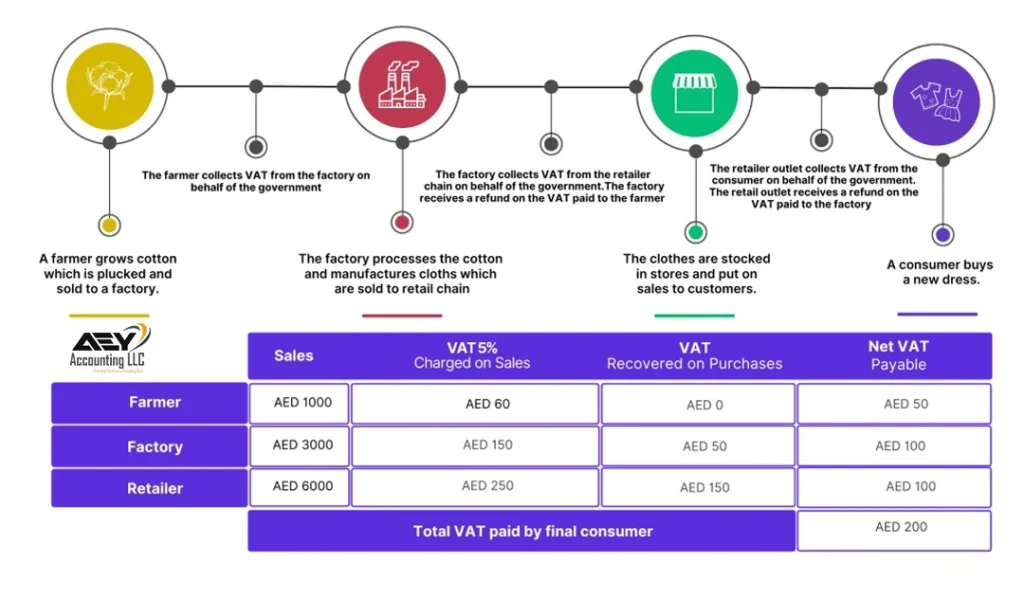
In the dynamic business landscape of the United Arab Emirates (UAE), staying compliant with Value Added Tax (VAT) regulations is crucial for avoiding penalties and ensuring smooth operations. Introduced in 2018 under Federal Decree-Law No. 8 of 2017, VAT at a standard rate of 5% applies to most goods and services. However, when a business no longer meets the criteria for VAT registration, de-registration becomes essential
This comprehensive guide explores VAT de-registration in the UAE for 2026, covering eligibility, step-by-step processes, penalties, recent updates, and best practices. Whether you’re winding down operations, restructuring, or your turnover has dropped, understanding how to de-register VAT in UAE can save you time and money.
VAT de-registration, also known as VAT cancellation or deregistration, is the official process of removing your business’s Tax Registration Number (TRN) from the Federal Tax Authority (FTA) records. It’s mandatory when your business ceases to qualify for VAT registration, preventing unnecessary compliance burdens and potential fines. Unlike registration, which is often proactive, de-registration ensures you’re not liable for ongoing VAT filings after eligibility ends.
In 2026, with the UAE's tax system maturing under amendments like Federal Decree-Law No. 17 of 2025 (updating Tax Procedures) and No. 16 of 2025 (VAT Law), de-registration aligns with enhanced compliance and anti-evasion measures. Businesses must act promptly to avoid extended audit risks, now up to 15 years in evasion cases. De-registration doesn't erase past liabilities; all dues must be settled before approval.
De-registration isn’t optional in many cases—it’s required by law. The FTA distinguishes between mandatory and voluntary de-registration based on your business’s taxable supplies (goods/services subject to VAT at 5% or 0%). Taxable supplies exclude exempt items like certain financial services or residential rents
You must apply if:
- Your business stops making taxable supplies entirely (e.g., due to closure, license cancellation, or liquidation).
- The value of taxable supplies in the previous 12 consecutive months falls below the voluntary registration threshold of AED 187,500, and you don’t anticipate exceeding it in the next 30 days.
Failure to de-register mandatorily can trigger penalties and ongoing filing obligations.
You may apply if:
- Taxable supplies in the last 12 months are below the mandatory registration threshold of AED 375,000, but above AED 187,500, and you choose to opt out for operational reasons.
This is common for small businesses seeking to reduce administrative costs. However, if you’re in a VAT group, de-registration affects the entire group—consult the FTA first.
| Threshold Type | Amount (AED) | Description |
|---|---|---|
| Mandatory Registration | 375,000 | Required if taxable supplies exceed this in 12 months or projected to in 30 days. |
| Voluntary Registration | 187,500 | Optional registration for supplies above this but below mandatory. |
| Mandatory De-Registration | Below 187,500 | Must de-register if supplies fall below and no projection to exceed. |
| Voluntary De-Registration | Below 375,000 | May de-register if below mandatory threshold. |
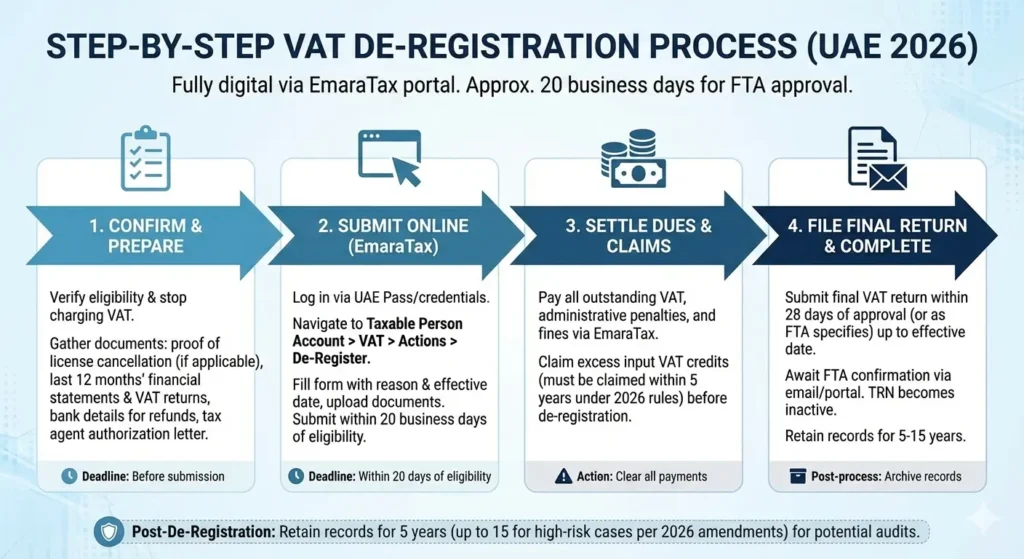
The process is fully digital via the EmaraTax portal, taking about 20 business days for FTA approval if complete. Here’s a detailed 4-step checklist, updated for 2026’s streamlined procedures:
Post-de-registration, retain records for 5 years (or up to 15 in high-risk cases per 2026 amendments) for potential audits.
De-registration is free—no service fees apply under Cabinet Decision No. 174 of 2025, which eliminated paper-based charges in favor of digital processes. However, non-compliance carries costs:
In 2026, with enhanced anti-evasion rules, FTA can deny input tax recoveries linked to fraud, adding indirect costs. Total potential penalties could exceed AED 20,000 for delayed or incomplete processes.
| Violation Type | Penalty Amount (AED) | Notes |
|---|---|---|
| Late De-Registration Application | 10,000 | Maximum; applied automatically. |
| Failure to File Final Return | 1,000–5,000 | Per month delayed. |
| Unpaid VAT Liabilities | 4% monthly interest | Plus base fine of AED 500–3,000. |
| Record-Keeping Violations | 5,000–20,000 | Post-de-reg audits. |
The UAE’s tax reforms, effective January 1, 2026, indirectly impact de-registration:
These stem from FTA’s 2023–2026 strategy for risk-based enforcement.
Income generated from qualifying intellectual property, such as patents or copyrighted software, is considered qualifying income, provided it meets the criteria outlined in the decision. However, income from non-qualifying intellectual property is taxable.
Common pitfalls: Assuming automatic de-reg or ignoring the 20-day clock.


Whatever your question is, our team will lead you to the right direction.
+971 56 413 4070
Your business is special. Let us calculate your dreams
Typically 20 business days, but up to 40 if additional info is needed.
Yes, if you meet thresholds again—apply via EmaraTax.
Yes, if under mainland VAT rules
Stricter enforcement, but no increase in base amounts.