

- +971 4242 5253
- [email protected]
- Mon - Fri: 9:00 - 18:30
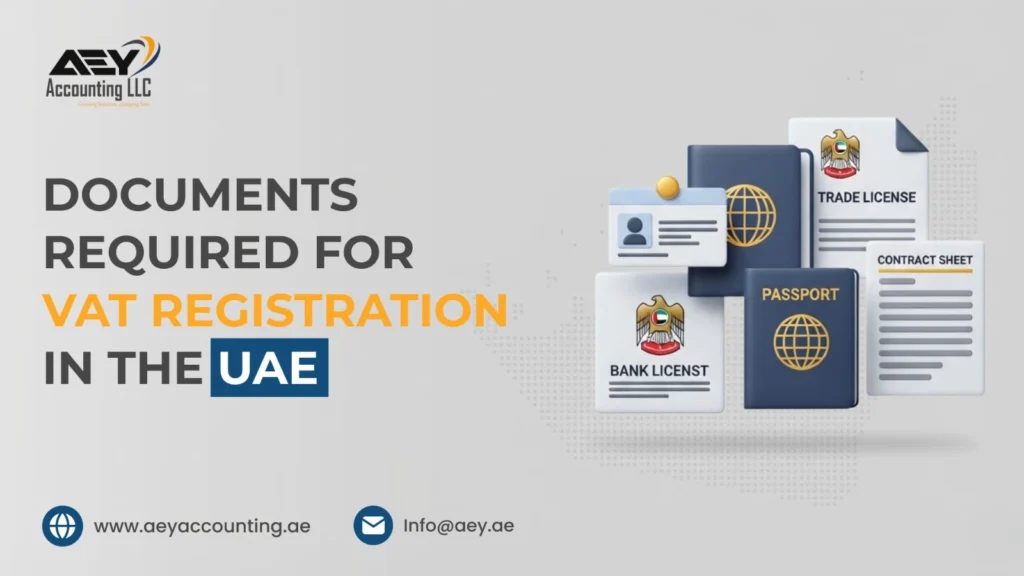
If you’re planning to register your business for VAT in the UAE, the very first step is preparing the correct documents. Over the last 10 years of working with hundreds of companies in Dubai, Sharjah, Abu Dhabi, and various free zones, I can tell you one thing with full confidence:
“Most VAT registration delays happen simply because businesses submit incomplete paperwork.”
The Federal Tax Authority (FTA) is extremely strict, and even a minor mismatch—like a wrong passport copy or an outdated trade license—can easily push your application back by 2–6 weeks.
This guide is written to give you every document, rule, hidden requirement, expert insight, and practical UAE-specific advice you need to complete VAT registration without delays.
VAT registration is the process where a business officially registers with the Federal Tax Authority (FTA) and receives a Tax Registration Number (TRN). This TRN becomes your identity for all tax filings, VAT return submissions, refund claims, and compliance processes.
Under Federal Decree-Law No. 8 of 2017, any business crossing the mandatory threshold must register.
There are two types of VAT registration:
A business may register if:
Annual turnover exceeds AED 187,500
Expenses subject to VAT exceed AED 187,500
In my experience, many startups voluntarily register early because:
They want to claim input VAT on expenses
They want a stronger corporate image
Some clients only work with VAT-registered suppliers
A business must register if:
Annual taxable supplies exceed AED 375,000
Expected future turnover will exceed AED 375,000
Let me give you an example from my own experience.
A trading company in Sharjah approached me last year. Their VAT registration was stuck for 54 days, and the reason was shockingly simple:
They uploaded a trade license that expired 6 weeks earlier.
The FTA will never approve a VAT application with:
Once they corrected the documents, their TRN was issued within 5 working days.
Below is the complete and detailed version (the brief list was already given at the top).
Your trade license must be:
Many businesses don’t notice that the activity listed on the license must match the VAT activity declared on the FTA portal.
Provide a clear, full-color passport copy of:
The FTA rejects:
This must match the passport and trade license exactly.
A common issue:
The Emirates ID number doesn’t match the passport or spelling in the trade license.
Result: FTA rejects instantly.
This document shows:
If your MOA was amended, include all amendment pages.
If someone other than the owner is completing VAT registration, this letter is mandatory.
Most FTA delays in free zones happen due to missing POA.
Not always required, but recommended.
For new companies:
For existing companies:
You can submit:
FTA only accepts documents proving AED 375,000+ turnover.
This should include:
The account must be under the company’s name, not an individual.
For trading companies, include:
import/export code
customs declaration forms
FTA uses this to assess VAT applicability.
Required to confirm the UAE location of your business.
You must write a clearly defined explanation of what your company does.
FTA requires:
Here is the same process I use for clients at AEY:
Visit the official FTA portal and register with:
Includes:
Ensure every document is clear in PDF format valid
Once submitted, it goes under review.
If approved, you receive your Tax Registration Number via email.
Below is the pricing table commonly seen in the UAE:
Service | Mainland Price (AED) | Free Zone Price (AED) |
VAT Registration | 500 – 1,500 | 600 – 2,000 |
VAT Return Filing (per month) | 300 – 1,000 | 400 – 1,200 |
VAT Accounting Setup | 800 – 3,000 | 900 – 3,500 |
VAT Advisory | 300 – 700 | 350 – 800 |
Criteria | Mandatory VAT | Voluntary VAT |
Threshold | AED 375,000 | AED 187,500 |
Required? | Yes | Optional |
Recommended for Startups? | No | Yes |
TRN Approval Speed | Faster | Slight delay |
Input Tax Claim | Yes | Yes |
FTA rejects instantly.
Activity must match trade license.
Absolutely not allowed.
FTA will not approve without proof.
You will miss TRN notifications.
Based on 2024–2025 trends:
Fastest TRN issue: 3 business days
Average: 5–12 working days
Delayed: 20–40 days (if documents incorrect)
Yes—if they exceed the threshold.
Even if you’re in:
You must register if you hit the limits.
Use this to avoid delays:
If you want your VAT registration handled professionally, with zero mistakes, you can contact a VAT expert in UAE. A proper consultant ensures:


Whatever your question is, our team will lead you to the right direction.
+971 56 413 4070
Your business is special. Let us calculate your dreams
Usually yes—registration obligations are not solely profit-based. Check your facts.
An election that may allow eligible small businesses to treat taxable income as zero for a period—records and filings still matter.
Not automatically. You must assess QFZP status, qualifying income, and substance. Non-qualifying income can be taxed at the standard rate.
If you have related-party transactions, arm’s-length and proportionate documentation still apply—even for SMEs.
Typical timelines are 5–15 working days, depending on documents and queries.